
Overcoming Misogyny: Transformation, Truth-Telling, and the Long Work of Becoming
Dorothy Greco in conversation with Tia Levings

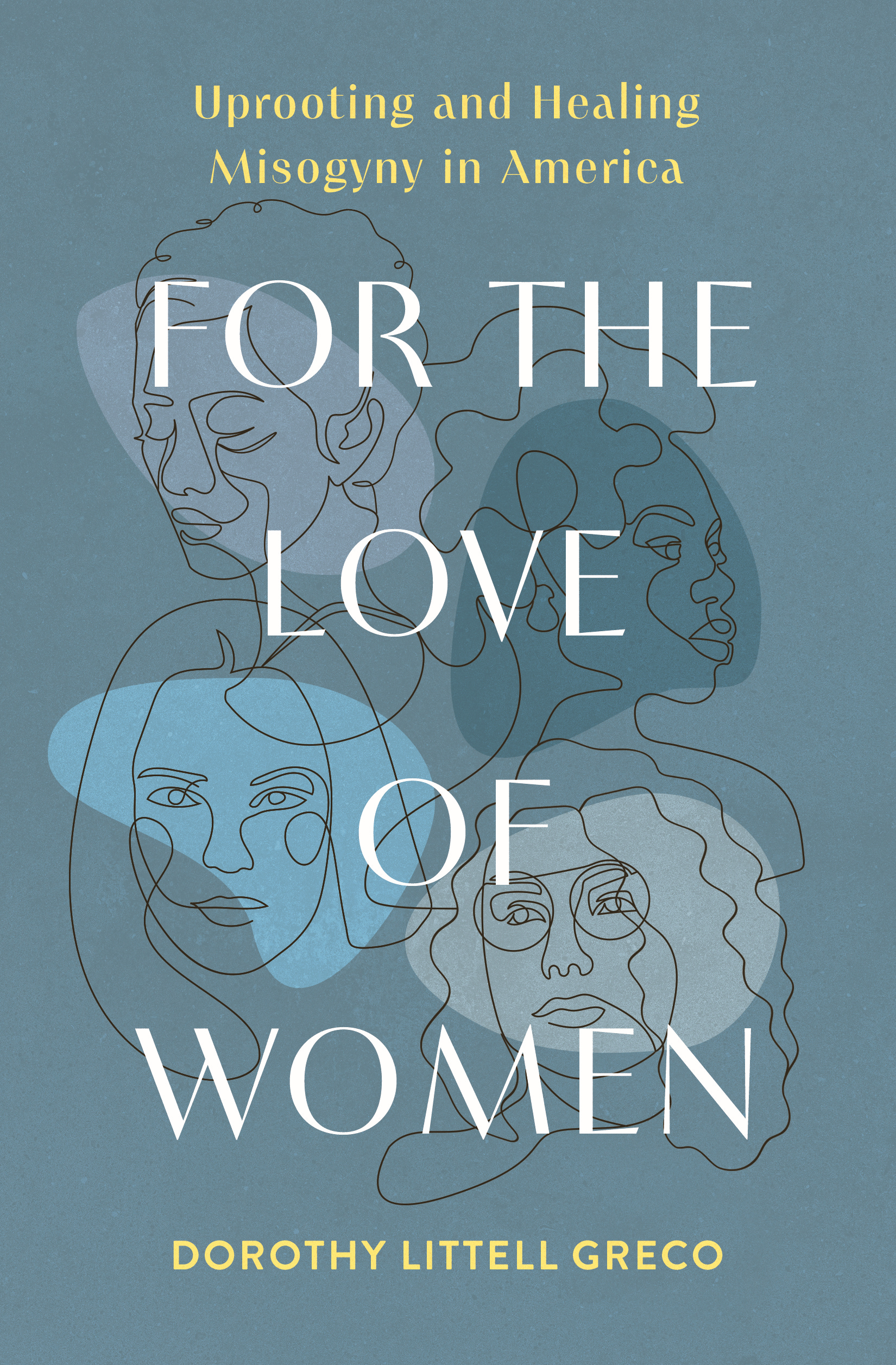
I recently read and blurbed For the Love of Women: Uprooting and Healing Misogyny in America by Dorothy Littell Greco. Although it’s published by Zondervan and speaks directly to the misogyny plaguing Christianity, this work is also a broad look at how misogyny stubbornly lingers in every sector of our culture, including progressive spaces. I don’t think non-Christians in America should skip it.
The book opens with a definition. Misogyny: A persistent, insidious belief that men’s ideas, wants, needs, and experiences are more important than women’s, and that legal, religious, and social systems, as well as intimate relationships, should uphold this principle. This belief system subsequently influences the laws, practices, and ethos of a given culture.
Dorothy and I enjoyed a warm and in-depth conversation about our respective works, experiences, and perspectives on misogyny, faith, and personal transformation. Dorothy shared insights from her book and the journey it was to write it at this point in her career, and we exchanged thoughts on the challenges of writing about sensitive topics, the importance of empathy and transformation, and the need for visibility and representation of older women.
Coming soon for paid subscribers: a video series of writers talking shop, creative process, side projects, and fun. This feature will also be available in podcast format. Dorothy was the first guest in this project. The portion of the interview covering the author’s work and focus will remain free to the public, and I hope you both enjoy it and get her book. Here’s our conversation, a wide-ranging chat between two writers about faith, creativity, marriage, reinvention, and the slow, sacred work of personal transformation.
As authors, we both do a lot of interviews to promote our work and spread the word. Some of the richest conversations happen when both partners have read each other’s books, and that was evident from the opening notes of our session. Dorothy reread my memoir for a second time (thank you!) and was struck by something rare in personal storytelling: unflinching honesty without cruelty.
“You are such a truth-teller,” she said, “but you don’t descend into hatred or vitriol or meanness. You could have—but you didn’t.” I’d noted the same about Dorothy’s work; it’s imbued with humanity, courage, and nuance, while exploring stark binaries and strict gender roles. “I think as we talk about misogyny or other systemic injustices, it can be easy for us to follow our hurts,” she said. “If it becomes about hating men, or saying that we don’t need men, that we women are fine all our own, then we’re kind of missing the point.” (See more of her work here, including her stunning photography.)
That balance—courage braided with compassion—set the tone for the hour.
On telling the truth without losing your soul
Dorothy Greco has long written at the intersection of faith, relationships, and interior growth. For the Love of Women is her 3rd book, and she’s had an extensive career in photography. For this book, she examined misogyny in seven sectors: Healthcare, in the workplace, in the government, in entertainment and media, in intimate relationships, and in the church.
For her, truth is inseparable from spiritual formation. “If we’re serious about pursuing Jesus—or whatever faith it is that one is after—there is a transformation that it asks of us,” she said. “When I look at his life and see the ways he was sacrificial and kind, a truth-teller who wasn’t afraid to confront injustice—that’s the template for me.”
Transformation, she explained, is the through-line in all her work. It’s even reflected in the tagline she’s used for years: faith is meant to transform everything.
“The ways that Jesus treated women were remarkable. They broke so many of the cultural and social boundaries of the time, and he valued them, listened to them, cared for them, ministered to them, spoke the truth to them, and clearly trusted them. So, I think that if more men and more churches treated women and loved women like Jesus did, then misogyny would fall. And that, you know, was really the origin of the title of the book, For the Love of Women. It’s if we could understand what it means to love.”
Marriage as a long practice of becoming
Greco and her husband have been married for 34 years—a length of time that, she’s quick to point out, doesn’t signal ease. Her other two books, Making Marriage Beautiful and Marriage in the Middle, underscore the relational investment.
“Our relationship has taken a lot of work,” she said with a laugh. “We are such different people that when we did premarital counseling, the pastor looked at our personality test results, took a deep breath, and said, ‘We need to talk about what conflict is going to look like.’”
What has sustained them, she said, is a shared commitment to change—not just hoping the other person will grow, but asking, How can I?
“Transformation is slow. You can’t just say, ‘I’m going to change,’ and then change,” she said. “Christopher and I are still working on some of the same things after 34 years. If we don’t have grace for each other—deep forgiveness and compassion—it gets really hard.”
I agreed. I see that same dynamic in the broader culture. “We have to give each other room to grow,” I said. “So many people cling to old versions of each other. But we are not meant to stay the same.”
She likened personal change to metamorphosis.
“The butterfly literally melts into itself in the cocoon. It’s not the same creature anymore. Our different life eras are like that—we are reincarnations of ourselves.”
The missing visibility of older women
Late in the conversation, the focus turned toward a group we both feel is too often erased: older women, particularly those coming out of rigid religious subcultures.
“We don’t see old ‘trad wives,’” I said. “They disappear. They get traded in, they get sick, they deconstruct, or they just fade quietly into invisibility.”
I’ve seen how years of overwork, neglect, and spiritual pressure take a toll. Some women face serious illness. Others experience mental health crises after decades of self-erasure. Many simply lose the sense that their voices matter. There’s something about visibility and value that’s necessary to our survival. We need to see these women. Their stories. Their faces. Their wisdom.
Dorothy agreed. “That visibility is so important,” she said. “Being able to listen to people’s stories, being able to hear the experiences that they’ve had, and to be in their spaces with them, and then to try to portray them in a way that’s honoring.”
We discussed the four eras or seasons of a woman’s life: Maiden, Mother, Queen, Crone. Patriarchy takes us pretty much from mother to crone. Once you’re not having babies anymore, you’re an invisible old lady. Relevance is tied to fertility.
But, with menopause, there’s this whole era of a queen that has not been claimed. And this generation of women, us, younger boomers, X, older millennials: we’re all either perimenopausal, menopausal, or post, so we’re all in this queen overlap. We’ve all trailblazed in our own ways, and persisted, and endured, and learned a lot, but we’re in a different era now. We don’t need to do the things we did when we were young mothers. What does that look like? This is a whole new territory that’s barely been explored in history. What art will the Queens make? What stories will they tell?
For both of us, this work—telling the truth, honoring complexity, making space for growth—isn’t just literary. It’s cultural and spiritual. We have to keep showing up. Clearing paths. Making room for voices that need to be heard and realities that need to be told.
And, as Greco’s life and work suggest, trusting that even the slowest transformations are still holy work in motion.
Dorothy Littell Greco has spent the last forty years thinking, writing, and talking about how the gospel is meant to change everything. She also works as a professional photojournalist. When Dorothy is not behind the camera or in front of her computer, she enjoys biking, going for long walks, kayaking, sharing GF food with friends, and trying to make her grandson laugh. She also writes the Substack, What’s Faith Got to Do With It?
What lands here is the refusal to turn truth-telling into a blood sport. Naming misogyny without turning men into cartoon villains or women into saints is harder work, and it shows. The part about transformation being slow, unglamorous, and unfinished feels especially honest. Also yes to the erasure of older women. Patriarchy loves a woman right up until she stops being useful to it. The Queen era you name feels like the plot twist history never planned for and desperately needs. This is the kind of conversation that actually changes rooms, not just minds.
What this post awakened within me is the sense that the feminine carries an extraordinary capacity for self-renewal (a magical capacity to give birth to herself over and over and over again). There is a willingness AND DESIRE to enter cycles that require descent, to move downward into uncertainty, grief, or unknowing; trusting that something essential is forming there. The momentum of going down is that we (all of us) reach a higher point as we spiral upwards again. This rhythm of eternally dissolving and re-emerging feels ancestral, cellular, and deeply intelligent. Each return carries more depth, more clarity, more authority earned through experience rather than assertion. Because the feminine is generous, this gets infused into the world.
There is something profoundly powerful about honoring this cycle as a strength rather than a liability. The repeated movement through darkness and emergence is how wisdom becomes embodied, how insight gains weight and resonance. When this capacity is respected and protected, it changes how we understand leadership, creativity, and spiritual maturity. It feels like a superpower that deserves reverence, space, and cultural recognition, especially in a world that rushes toward permanence, emotional enslavement and certainty rather than transformation.